

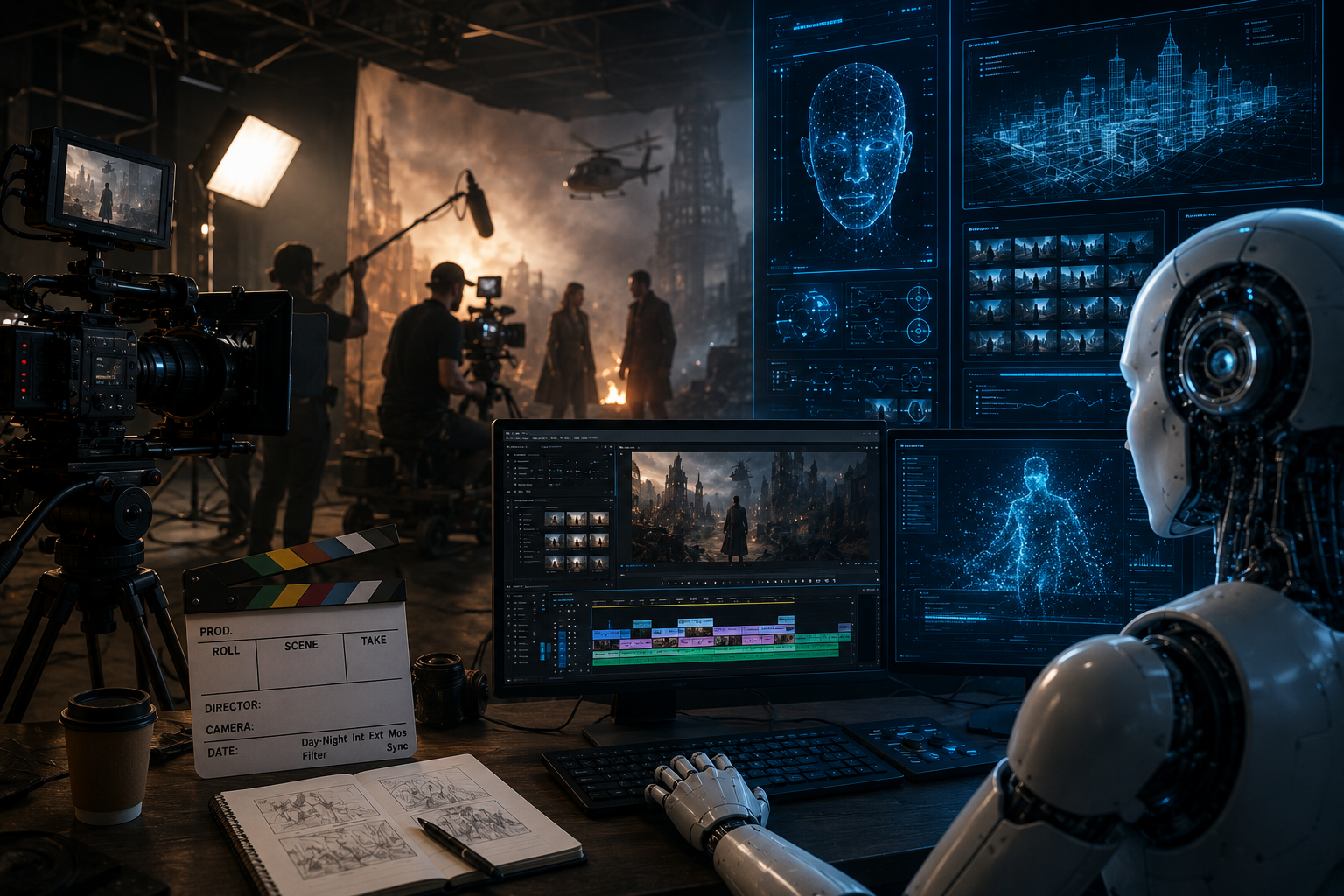
Artificial Intelligence (AI) is no longer just a science-fiction concept shown in movies. Today, AI itself is becoming one of the biggest technologies shaping the future of filmmaking and the entertainment industry. From scriptwriting and video editing to visual effects and digital actors, AI is transforming how movies are created, produced, marketed, and distributed.
The film industry has always evolved with technology. From silent films to color cinema, practical effects to CGI, every generation of filmmaking has embraced innovation. Now, AI is becoming the next major revolution.
But an important question remains:
Is AI helping filmmakers, or replacing them?
The answer is more complex than a simple yes or no. AI is making filmmaking faster, cheaper, and more accessible, but it is also raising concerns about creativity, jobs, originality, and the future role of human artists.
In this article, we will explore how AI is changing filmmaking, the benefits and risks of AI in cinema, and whether AI could eventually replace human creators in the movie industry.
What Is AI in Filmmaking?
AI in filmmaking refers to the use of artificial intelligence technologies to assist or automate different stages of movie production. These systems analyze massive amounts of data, recognize patterns, generate content, and even make creative suggestions.
AI tools are now used in:
- Scriptwriting
- Casting decisions
- Storyboarding
- Video editing
- Voice generation
- Visual effects (VFX)
- Animation
- Music composition
- Marketing and audience analysis
- Deepfake and digital actor creation
Many Hollywood studios, streaming platforms, and independent creators are already integrating AI into their workflows.
How AI Is Helping the Film Industry
1. AI Scriptwriting and Story Development
AI-powered writing tools can generate scripts, dialogues, story ideas, and plot structures within seconds. Platforms trained on thousands of movie scripts can analyze storytelling patterns and suggest improvements.
Benefits:
- Faster brainstorming
- Writer assistance for dialogue and scenes
- Predicting audience engagement
- Generating multiple story versions quickly
AI can help screenwriters overcome writer’s block and improve productivity. However, human creativity and emotional storytelling are still difficult for AI to fully replicate.
Example:
Streaming platforms use AI analytics to understand what types of stories audiences prefer based on viewing behavior.
2. AI Video Editing
Traditional movie editing can take months. AI-powered editing software can now:
- Automatically cut scenes
- Sync audio
- Detect best shots
- Color correct footage
- Generate trailers
This dramatically reduces editing time and production costs.
Advantages:
- Faster post-production
- Reduced workload for editors
- Automated repetitive tasks
- Smart scene detection
Editors can focus more on creative storytelling while AI handles technical operations.
AI in Visual Effects (VFX) and CGI
Visual effects are one of the biggest areas where AI is revolutionizing filmmaking.
AI tools can:
- Generate realistic environments
- Create digital humans
- Enhance CGI
- Remove unwanted objects
- De-age actors
- Improve motion capture
Movies today can create highly realistic fantasy worlds with less manual work than ever before.
AI and Deepfake Technology
Deepfake technology allows filmmakers to digitally recreate faces, voices, and expressions.
This technology has been used for:
- Bringing younger versions of actors on screen
- Recreating deceased actors
- Dubbing movies in multiple languages realistically
While impressive, this also raises ethical and legal concerns regarding consent and identity rights.
AI in Animation and Virtual Production
Animation studios are using AI to speed up character animation, lip-syncing, and rendering.
AI helps animators by:
- Automatically generating movements
- Enhancing facial expressions
- Creating realistic physics simulations
- Reducing rendering times
Virtual production techniques, powered by AI and real-time engines, are becoming popular in both Hollywood and streaming content production.
This reduces costs and allows filmmakers to create massive cinematic worlds without expensive physical sets.
AI Voice Technology in Movies
AI-generated voices are becoming increasingly realistic.
Filmmakers can now:
- Clone voices
- Dub movies automatically
- Restore damaged audio
- Generate narration
Voice AI is especially useful for localization, allowing movies to reach global audiences more efficiently.
However, voice actors worry that AI-generated voices may reduce opportunities for human performers.
AI Actors and Digital Humans
One of the most controversial developments is the rise of AI-generated actors.
Digital humans can:
- Perform scenes
- Deliver dialogues
- Mimic emotions
- Appear realistic on screen
Some companies are already experimenting with fully AI-generated characters for advertisements, games, and short films.
Could AI Replace Actors?
Not completely at least not yet.
Human actors bring:
- Emotional depth
- Improvisation
- Real-life experiences
- Unique personality
AI may replace background characters or support visual production, but audiences still connect deeply with authentic human performances.
AI in Movie Marketing and Audience Prediction
AI is also transforming film marketing strategies.
Studios use AI to:
- Predict box office performance
- Analyze audience preferences
- Personalize recommendations
- Optimize trailers and posters
- Target advertisements more effectively
Streaming platforms heavily depend on AI recommendation systems to keep viewers engaged.
This data-driven approach helps production companies reduce financial risks.
Will AI Replace Filmmakers?
This is the biggest debate in the entertainment industry today.
Jobs Most Likely to Be Automated
AI may partially replace repetitive and technical tasks such as:
- Basic video editing
- Subtitle generation
- Audio cleanup
- Background VFX
- Basic animation tasks
- Data analysis
Jobs Less Likely to Be Fully Replaced
Creative and emotional roles remain harder for AI to replicate:
- Directors
- Story writers
- Cinematographers
- Lead actors
- Creative producers
- Artistic designers
Filmmaking is not only about technical execution it is about emotion, vision, culture, and human experience.
AI lacks true human imagination and emotional understanding.
Advantages of AI in Filmmaking
Faster Production
AI speeds up many production stages, reducing deadlines significantly.
Lower Costs
Independent filmmakers can create high-quality content with smaller budgets.
Better Accessibility
Small creators now have access to advanced tools previously available only to big studios.
Enhanced Creativity
AI can generate concepts, references, and visual experiments quickly.
Improved Visual Quality
AI-enhanced VFX and rendering produce more realistic cinematic experiences.
Risks and Challenges of AI in Cinema
Job Displacement
Many industry professionals fear losing jobs due to automation.
Ethical Concerns
Deepfakes and digital cloning raise legal and moral questions.
Copyright Issues
AI-generated content often uses existing creative data for training.
Loss of Human Creativity
Overreliance on AI may lead to repetitive and formula-based storytelling.
Audience Trust
Viewers may question authenticity if movies rely heavily on AI-generated performances.
The Future of AI in the Film Industry
The future will most likely involve collaboration between humans and AI rather than total replacement.
AI will become a powerful filmmaking assistant:
- Helping creators work faster
- Reducing production costs
- Expanding creative possibilities
But human imagination, emotion, and storytelling will remain essential.
The most successful filmmakers in the future may be those who learn how to combine human creativity with AI technology effectively.
Final Thoughts
AI is undoubtedly transforming the movie industry at an incredible pace. From scriptwriting and editing to digital actors and visual effects, artificial intelligence is changing nearly every aspect of filmmaking.
However, AI should not be viewed only as a threat. It is also an opportunity for creators, studios, and independent filmmakers to innovate and tell stories in new ways.
The future of filmmaking is not about humans versus AI it is about humans working with AI.
While AI can automate technical tasks and generate content quickly, true cinematic storytelling still depends on human emotions, experiences, and artistic vision.
The film industry is entering a new era, and AI is becoming one of its most powerful tools.
Conclusion
Artificial Intelligence is reshaping filmmaking by improving efficiency, lowering costs, and opening creative opportunities. At the same time, it raises important concerns about originality, ethics, and job security.
Whether AI becomes a supportive assistant or a disruptive replacement depends on how the industry chooses to use it.
 Raj Kumar